There is something strange about seeing Earth from space. From the surface, our world feels almost impossibly large and often disconnected. Countries, economies, cities and political systems dominate our attention, while environmental problems are discussed as separate issues happening somewhere “out there”. Move far enough away, however, and those distinctions disappear. What remains is a relatively small sphere moving through an enormous darkness, wrapped in a remarkably thin layer within which almost everything we have ever known has happened.
Astronauts have often described a profound shift in perspective after seeing Earth this way, an experience known as the Overview Effect. Borders disappear and the planet becomes visible for what it really is, one interconnected system and, as far as we know, our only home. I have been thinking about this perspective, and I keep coming back to one thought. Before asking what we should change, we should remind ourselves why any of it matters. That is something I think we risk losing when we talk about climate change, sustainability or “saving the planet”.
Perhaps the planet was never the thing that needed saving
I have become increasingly uncomfortable with the phrase saving the planet. Not because the problems behind it are unimportant, but because the framing creates a subtle distance between us and the problem, almost making it sound like a third-party issue. It makes Earth sound like an external entity that humanity has nobly decided to rescue, placing us in the role of the hero when the reality is almost the opposite.
Earth is an extraordinarily complex system made up of interacting subsystems such as the atmosphere, oceans, soils, vegetation, microorganisms, animals, water cycles and geological processes. Long before humans arrived, these systems changed and reorganised themselves through conditions very different from those we know today. We therefore have to accept that the physical planet will continue to exist regardless of whether it remains comfortable for us to live on.
What is far less certain is whether the conditions in which human civilisation has flourished will remain stable. When forests disappear, soils degrade, rivers become polluted or climatic conditions shift, we are not damaging some separate thing called “the environment”. We are altering parts of the system that provide our food, water, breathable air, climatic stability and protection from hazards. In other words, we are changing the conditions within our own home.
Terms such as climate change, biodiversity loss and land degradation are necessary for understanding and measuring these problems. I am not suggesting that we replace them with another slogan. I simply do not want the terminology to become detached from the reason we care.
Humanity has become extraordinarily successful at extracting value from the Earth system. We draw nutrients from soils, timber from forests, freshwater from rivers and aquifers, minerals from the ground and energy accumulated over millions of years. Extraction itself is not the problem because every living organism depends on its surroundings. The problem begins when we take faster and more than the system can regenerate, particularly when the process also damages its ability to recover.
There is an uncomfortable biological analogy here. A component of a living system that continually consumes resources while weakening the larger system on which it depends begins to behave like a parasite. Taken even further, it can become comparable to a cancer that grows successfully in the short term while ultimately undermining the system required for its own survival. It is an uncomfortable analogy, but at times it comes remarkably close to describing our relationship with the Earth system.
The good news is that this is not the only role available to us. Living systems also repair themselves. They regenerate, respond to damage and rebuild function. Humans can participate in that side of the system too. We can restore soils rather than continually exhaust them, rebuild wetlands, reconnect habitats, regenerate forests, improve water retention and rethink how we produce food and build cities.
This is why I find regeneration so compelling. It asks a more ambitious question than how we can simply become less destructive. It asks whether our presence can become useful to the larger system and whether we continue behaving predominantly as exploiters of the Earth system or increasingly become participants in its repair.
Ultimately, this comes down to a much more personal question.
What kind of world are we leaving behind?
For those with children, that question can be very direct. Many of the environmental conditions being shaped today will form the world in which they spend most of their lives. For those without children, the principle does not really change. Someone will live here fifty or a hundred years from now, and they will inherit the consequences of decisions in which they had no say.
I find it difficult to imagine anything more sobering than a future generation looking back at ours and recognising that we understood what was happening, possessed unprecedented scientific knowledge and technological capability, and nevertheless allowed short-term convenience to dominate. They should have the chance to experience the beauty we have been fortunate enough to inherit, including functioning landscapes, wildlife, forests, rivers, productive soils and ecosystems capable of supporting rich and diverse life. Ideally, we should want to hand over a world that is healthier, more resilient and more capable of sustaining them and the generations that follow.
That is the why we should be careful not to bury beneath the terminology, and it is also where I think the Earth observation industry has an important role to play.
From measuring the Earth to understanding what it means
One of the most frequently repeated principles in environmental management is that you cannot manage what you do not measure. Earth observation has transformed our ability to do exactly that.
Satellites allow us to follow changes in forests, crops, surface water, glaciers, cities, soil moisture, vegetation, fires, floods and many other parts of the Earth system. We can observe enormous areas repeatedly, detect changes that might otherwise remain invisible and follow processes unfolding over years or decades. In some ways, our industry provides a technological extension of the Overview Effect. We may not experience the same emotional shift as an astronaut looking through a spacecraft window, but we routinely work from a perspective that allows us to observe Earth as a connected system and, in turn, extend that perspective to others.
But you cannot manage what you do not measure contains two parts. Our industry has become extremely good at the measurement, while the reason for measuring was always to improve the management. This is the problem I have tried to represent with the EO Value Pyramid.
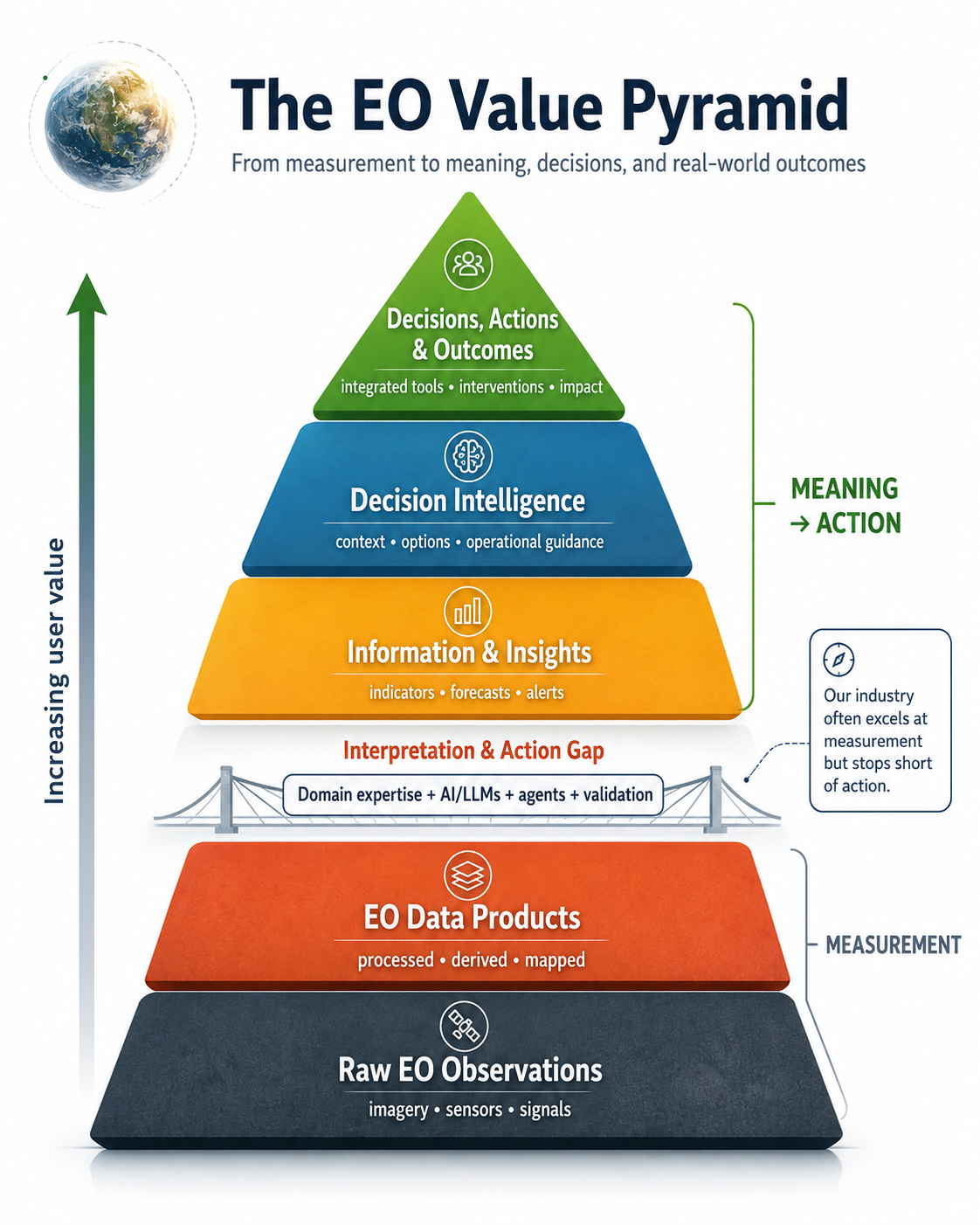
At its foundation are raw EO observations and the processed data products derived from them, which are areas where our industry has developed enormous technical expertise. Higher in the pyramid, however, the nature of the value changes. Data becomes information and insights, those insights become decision intelligence when combined with enough context, and ultimately that knowledge needs to reach decisions, actions and outcomes in the real world.
Yet there remains a substantial gap between these two halves of the pyramid. We produce scientifically rigorous datasets, sophisticated algorithms, machine-learning models, APIs, maps and dashboards, but there is often an implicit assumption that our responsibility ends once the technically correct product has been delivered. Someone else is expected to take it from there and translate it. Sometimes that works, while at other times the distance between the measurement and the person who needs to act is so great that much of its potential value is lost along the way.
This is what I think of as the Interpretation and Action Gap.
The value lies in speaking human
Closing that gap does not necessarily mean producing more data. Often it means making what we already know understandable in terms of consequences.
Imagine an EO system tells a farmer that pasture productivity is 30% below its seasonal baseline. That is useful information, but the more important question is what it actually means for the farm. Is there enough forage to carry the current livestock through the season, or will animals need to be moved, feed purchased or stocking reduced? With the right pasture, livestock and local contextual models, the translation could go further and estimate how many animals that land can realistically support.
That is what I mean by speaking human. It is not about sensationalising results or pretending EO provides certainty where it does not. Quite the opposite. Assumptions, uncertainties and limitations should remain clear. Nor does every remote-sensing scientist suddenly need to become an agronomist, hydrologist, ecologist and urban planner. We should, however, care whether the knowledge we generate can reach the people who can and should use it.
Our job titles may define our expertise, but they should not define the limits of our curiosity or responsibility. Science is valuable not simply because it produces accurate measurements, but because those measurements help us understand the Earth system and its subsystems. We may not be responsible for making every final decision, but we should help create a viable path towards it.
Until recently, doing that consistently and at scale was extremely difficult. That may now be changing.
Using AI to Speak Human
One of the reasons I find large language models and AI agents particularly interesting for Earth observation is not that I expect them to replace scientists or domain experts. Their more compelling role may be as part of the interpretation layer between technical information and the people who need to use it.
LLMs can help connect structured EO outputs with contextual information, supporting knowledge and language appropriate to a particular user. Agentic systems can go further by interacting with datasets, APIs, models and other information sources to assemble that context and help translate technical observations into something closer to actionable information.
This only becomes valuable when combined with scientific validation, transparent sources, appropriate guardrails and domain expertise. A confidently wrong interpretation is worse than an inaccessible dataset. The opportunity is therefore not to hand decisions over to AI, slap a disclaimer on the output and hope for the best. Instead, we can use these tools to help bridge the distance between those who generate knowledge and those who need to act on it.
In practical terms, they may help us move further through the value pyramid by progressing from what does the satellite observe? to what does it mean here?, then to why does it matter?, and ultimately to what decisions should now be considered? That journey has historically been difficult to scale, but we now have tools that could help us narrow the gap substantially.
What will we do with the view?
This brings me back to the Overview Effect. Earth observation gives us an unusual privilege because we get to see things that most people cannot. We can observe forests disappearing, crops beginning to struggle, water vanishing from landscapes, cities becoming hotter and ecosystems gradually losing resilience. Our industry has built an extraordinary ability to notice changes across our planet, but noticing only matters because it creates the opportunity to respond.
The purpose of Earth observation therefore cannot ultimately be another satellite image, another dataset or another dashboard. Those things are essential, but they are the foundation rather than the destination. Their real value lies in what someone is able to understand because of them, the decisions that understanding enables and, eventually, the outcomes those decisions create.
That is why I think the work we do in this industry is so important, and why we should be willing to carry the value further up the EO Value Pyramid. We should definitely continue building better sensors, algorithms, models and data products, but become equally serious about translating those measurements into meaning and making that meaning accessible to the people who can act.
We do not need to cast ourselves as the heroes who will “save the planet”. We have simply become remarkably good at seeing what is happening to the only home we have, and with that ability comes responsibility. The generations who come after us will not live with our datasets. They will live with the outcomes of the decisions those datasets helped, or failed, to inform.
Perhaps the question they eventually ask of us will therefore not be whether we managed to save the planet.
It will be
Once we could clearly see what was happening to our only home, what did we choose to do with that knowledge?